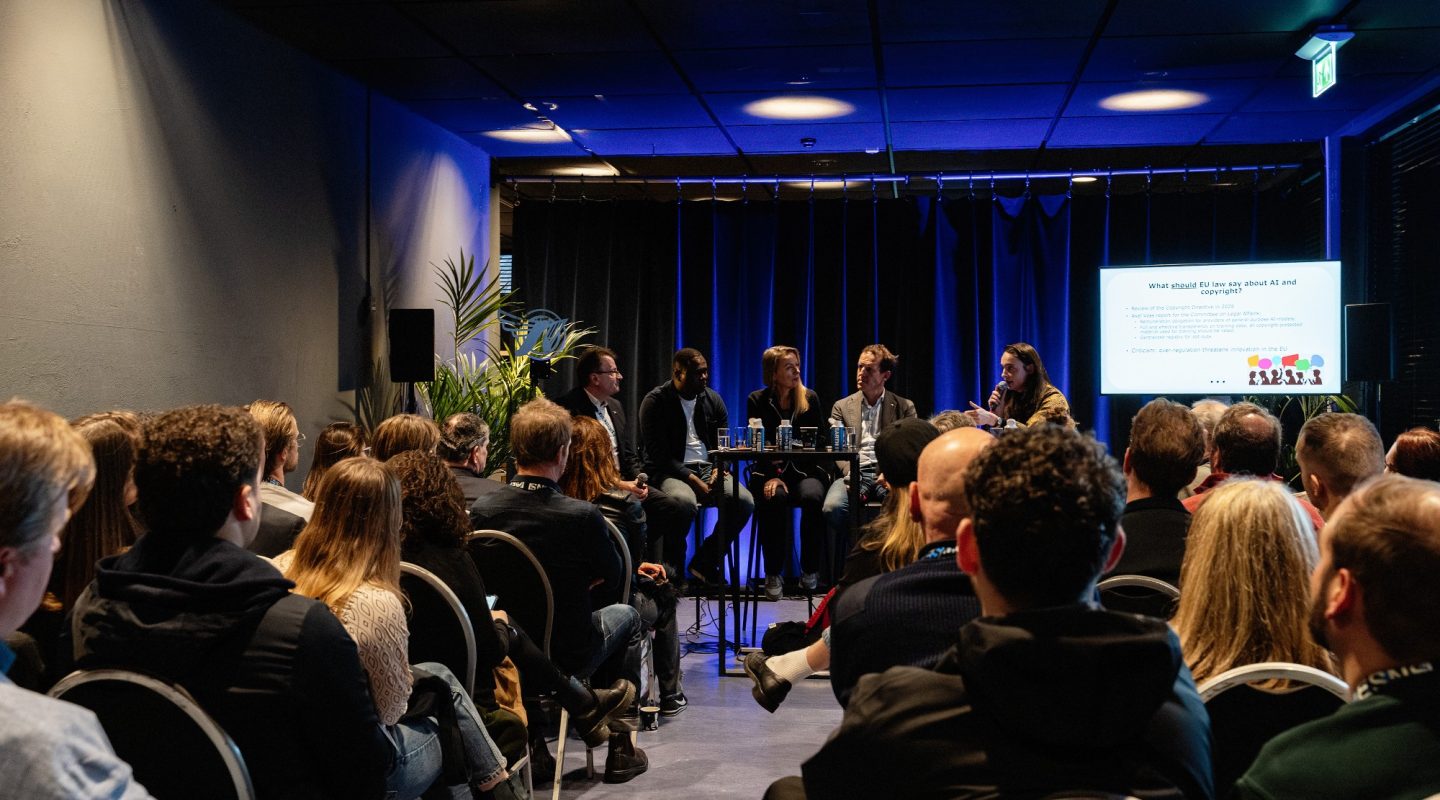
BumaStemra puts AI theme center stage during ESNS 2026
During Eurosonic Noorderslag 2026, AI was high on the agenda. The topic keeps the music industry, music creators, and music users fully occupied. BumaStemra organized five panels in which we addressed the impact of AI on music from different perspectives. The halls were packed, the discussions were sharp, and one thing became crystal clear: collaboration and knowledge sharing are crucial to continue safeguarding the interests of music creators.
Three pillars: transparency, compensation and consent
Three major topics came up in all conversations: transparency, compensation and consent. Because although AI companies train their systems on millions of musical works, music creators still lack clear safeguards. Sherlo Esajas (BumaStemra) put it this way during the panel on European copyright legislation: “Platforms and creators are part of the same music ecosystem, but that ecosystem can only flourish if creators get transparency, control and a fair share of the value.”
That value is under pressure. Member of European Parliament Hannes Heide was crystal clear about this: “Value is already being taken away from creators. Doing nothing is not an option. Europe must protect innovation, creators and consumers, and have confidence in its own values when shaping legislation.“
Concrete steps: from attribution to AI labels
BumaStemra doesn’t stop at words. Michiel Laan indicates that BumaStemra is working on a license for AI platforms for training on the BumaStemra repertoire, whereby we settle based on the value of the material used; that value lies not only in the ability to train, but especially also in the value of the music that is subsequently created with the help of AI. The challenge is to establish the connection between that input and output. BumaStemra will test this in a trial with various tech partners. With this technique, the input in the AI model (the training material) is linked to the output, and thus the value of the BumaStemra repertoire for training the AI model can be established. Furthermore, Michiel indicates that prompted AI music should not, in BumaStemra’s opinion, share in the royalty pool of Online Music Providers. The money (the royalties) must go to human creativity.
A lot is also happening on streaming platforms. Maria Garrido (CMO Deezer) shared striking figures: 50,000 AI tracks are uploaded to Deezer daily – about a third of the total. But these tracks only receive 0.5% of streams, of which 70% turns out to be fraud. “AI listening to AI,” according to Garrido. Deezer labels AI tracks with its own detection technology and removes them from editorial playlists. Moreover, research by Deezer and Ipsos shows that listeners aren’t waiting for AI music. They still prefer music from real artists over AI-generated music. And they want to be able to see what is AI and what isn’t.
Michiel Laan (BumaStemra) further emphasized that AI music, in his opinion, should not share in the royalty pool of streaming services: “The money must go to human creativity.“
Who bears responsibility?
Labeling of AI content is a shared responsibility, stated Maria Garrido. Not only platforms, but also distributors must take their role. Journalist Liz Pelly went even further: labeling should be legally mandated, so that listeners can make a conscious choice. She also called on artists and authors to speak out more clearly about the impact of AI on human creativity.
Helienne Lindvall (ECSA) and Liz Pelly were particularly concerned during the streaming panel about deals between labels and AI platforms, the content of which is not fully transparent. Both recognize the importance of collective management to stand up for all authors – not just the big names.
Technology as problem and solution
Can AI be both the problem and the solution? During the panel on deepfakes and copyright infringements, it became clear that detection technology is developing rapidly. Ashley Burgoyne (UvA) indicated that it is theoretically possible to link the output of an AI model to the input: “The mathematical formulas already exist, but it’s complex.” The University of Amsterdam is working on an open source reference model that can help external parties understand what happens in an AI model, and that can be used to demonstrate the value of training repertoire.
Etienne Valk (UvA) hopes that the burden of proof will be reversed: rights holders shouldn’t have to prove that their works were unlawfully trained on, but AI companies should have to prove that they did not do so. This requires adjustment of legislation, and Europe is leading the way in this.
Daan Archer emphasized that good metadata registration is crucial. Only in this way can we track who has and hasn’t given consent for AI training, especially when multiple rights holders are involved with one track.
What’s at stake?
Besides the direct income for music creators, there’s more at play. In the panel on background music in retail and hospitality, it was discussed that AI generated music threatens to displace human creators from one of their most reliable income sources. The Music360 project showed that music is more than background noise: it influences staff motivation, customer experience and even sales results. When every store and café is filled with the same synthetic soundtrack, not only income disappears, but also local musical identity and the opportunity to discover new talent.
Knowledge sharing and collaboration first
BumaStemra doesn’t stand alone in this fight. We work together with policymakers, tech partners, sister organizations and the music industry. During the live Q&A with our legal team, conference visitors could ask their questions about music rights and AI – an accessible way to inform and support creators and industry.
The future? We view it cautiously optimistically. Attribution technology will develop rapidly, and human creativity remains essential. As Ashley Burgoyne put it: “In ten years, AI will simply be one of the tools in an artist’s toolkit.“
BumaStemra continues the conversation. We share knowledge, build solutions and stand for fair compensation. Because innovation and creativity must go hand in hand – with respect for the creators who bring music to life.
Read more about AI and the music industry on www.bumastemra.nl/en/ai